ISTP
The everyday you
As an ISTP, you take things apart to see how they work, and you trust what holds together. You watch quietly, notice what is actually there, and act fast when a problem finally shows. Underneath, you sense where things are going. And your weakest habit, the one that embarrasses you fastest, is tending feelings, yours and everyone else’s.
Take the free quiz Compare two types
The four selves
making it make sense Ti · noticing what's here Se · sensing where it's going Ni · tending the room Fe
At your best you are the one to have around when something breaks: tolerant, flexible, a quiet observer who is suddenly and precisely useful. The cost is what you leave unsaid and unplanned. Emotional expression, the long-term commitment, and the slow work of staying engaged are the habits you trust least.

tending the room Fe · sensing where it's going Ni · noticing what's here Se · making it make sense Ti
You admire the person who reads a room, brings everyone along, and says the warm thing out loud without embarrassment. That attunement is your weakest habit turned into her strength, so it draws you and it measures you. You reach for it by naming one feeling, once, to one person who will not make a thing of it.

making it work Te · comparing with what's been Si · seeing what could be Ne · staying true Fi
Under stress the detached observer turns raw: touchy about being ignored, tearful or sentimental in ways you cannot stand, insisting on a logic that is going nowhere. That is your Unconscious, your four habits turned the other way. It is also why a by-the-book person who organizes everyone to the same standard can be the hardest for you to bear.
staying true Fi · seeing what could be Ne · comparing with what's been Si · making it work Te
When you are on duty you play the idealist: gentle, loyal, steering by what you believe and seeing what someone could become. You can hold it for a friend who needs it. Held longer it wears on you, because it is built from the habits you own least, and it leaves the practical problem in front of you unsolved.
one type, four selves:
across = reversed · down = turned
EastYour family
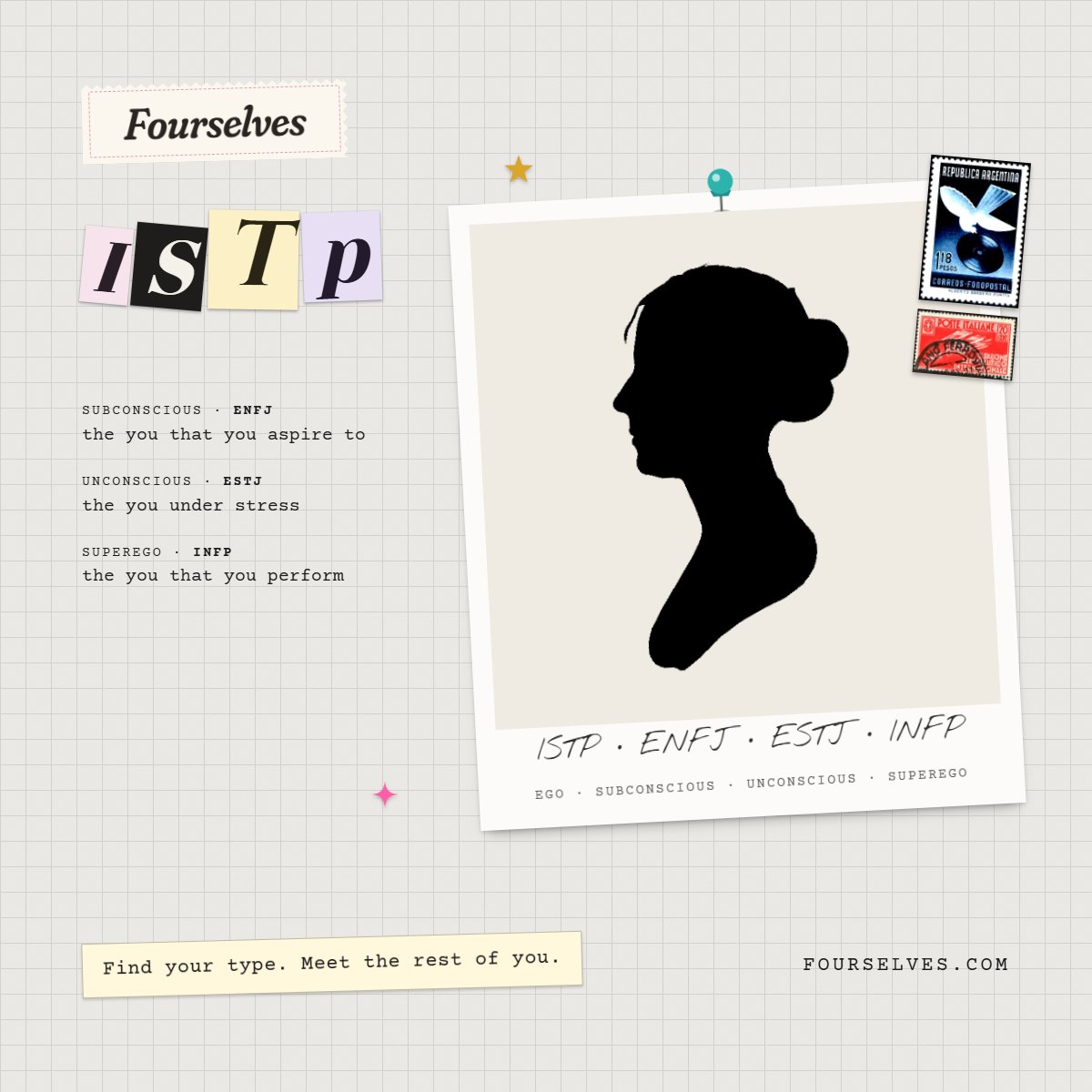
An ISTP’s four selves are ISTP, ENFJ, ESTJ, and INFP. Those four types share one set of selves, which makes them a family, and every one of the sixteen types belongs to one of four families. That is why your other three are the same as every other ISTP’s, and why they can be compared with anyone’s. ISTP is in the East family.
The types most often mistaken for yours
| Your type, or its neighbor | The question that separates them |
|---|---|
| ISTP or INTP | Both Ti-lead; auxiliary Ne vs Se. Does your analysis attach to abstract possibility and theory, or to tangible reality and physical systems? Same logical engine; different fuel. |
| ISTP or ISTJ | One letter, zero shared functions. Do you lead with stored experience and procedure, or with in-the-moment analysis of how things work? |
| ISTP or ESTP | Same functions, different lead: analysis first (Ti) or the present moment first (Se)? |
A detail worth knowing: for introverts, the last letter describes the second function, not the first. Your lead function works on the inside; what the world sees is the second. That is why the types below can look alike from the outside and feel completely different from within.
The workbook
Go deeper, on paper. A workbook for your type, with a chapter for each of your four selves and questions about your own week rather than your traits. It comes as a PDF to print at home, or to fill in on a tablet with a stylus.
The workbook for your type. Fifty-five pages, a chapter for each self, mostly questions to write about.
$14 · PDF Coming soon
Your four selves, as a signature
Your type, and the three that come with it, on one card. Save it, post it, or send it to someone who should take the quiz.
Save the card