ESTJ
The everyday you
As an ESTJ, you decide and you act, and you organize the people and the project so that it gets done the efficient way. You draw on tested experience and clear procedure. You can see a possibility when the plan needs one. And your weakest habit, the one where you are most easily wounded, is staying true to your own private values and to what other people feel.
Take the free quiz Compare two types
The four selves
making it work Te · comparing with what's been Si · seeing what could be Ne · staying true Fi
At your best you are the natural administrator: practical, realistic, decisive, the keeper of standards and the one who puts a decision into action the same afternoon. The cost is rigidity, impatience with anything unproven, and a blind spot for what other people feel until it stops the work.

staying true Fi · seeing what could be Ne · comparing with what's been Si · making it work Te
You admire the person who lives by what she believes, sees what someone could become, and accepts people as they are until a value is crossed. That quiet idealism is your weakest habit turned into her strength, so it moves you and it measures you. You grow toward it by asking what matters before asking what works.

making it make sense Ti · noticing what's here Se · sensing where it's going Ni · tending the room Fe
Under stress the administrator goes soft in a way you hate: sudden tears you hide, ordinary remarks heard as attacks, a sense of being used and unappreciated. It passes in hours. That is your Unconscious, your four habits turned the other way. It is also why someone who ignores the procedure and quietly does it her own way can drive you to distraction.
tending the room Fe · sensing where it's going Ni · noticing what's here Se · making it make sense Ti
When you are watched you play the mentor: warm, encouraging, attuned to everyone, bringing people along by feel rather than by the plan. You can carry it through a team meeting. Carried longer it exhausts you, because it is built from the habits you own least, and it hides the standard you are actually holding.
one type, four selves:
across = reversed · down = turned
EastYour family
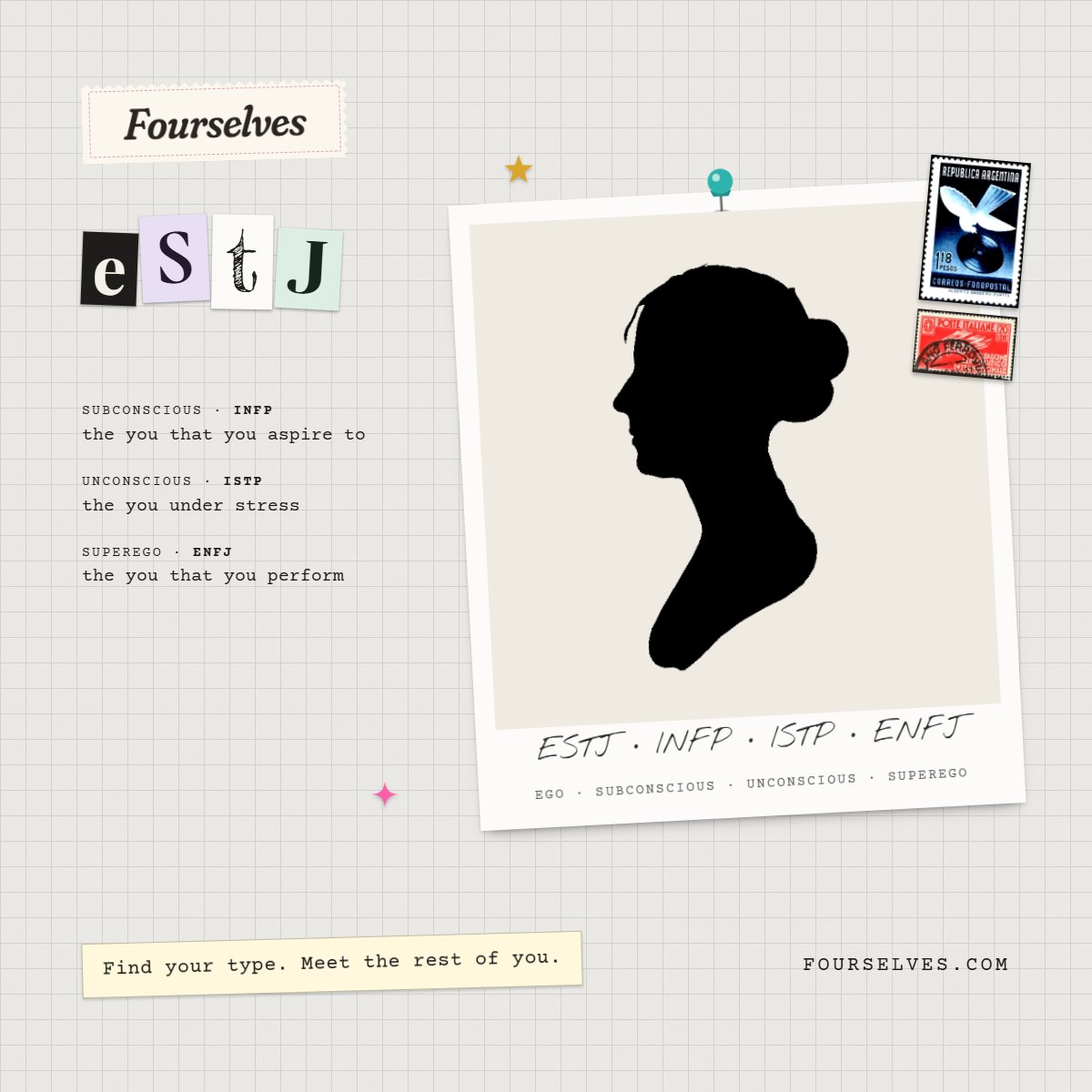
An ESTJ’s four selves are ESTJ, INFP, ISTP, and ENFJ. Those four types share one set of selves, which makes them a family, and every one of the sixteen types belongs to one of four families. That is why your other three are the same as every other ESTJ’s, and why they can be compared with anyone’s. ESTJ is in the East family.
The types most often mistaken for yours
| Your type, or its neighbor | The question that separates them |
|---|---|
| ESTJ or ENTJ | Both Te-lead; auxiliary Ni vs Si. Order or creativity: tested method and precedent, or emerging patterns and rewriting the rulebook? |
| ESTJ or ISTJ | Same functions, different lead: outward organizing first (Te) or the remembered standard first (Si)? |
The workbook
Go deeper, on paper. A workbook for your type, with a chapter for each of your four selves and questions about your own week rather than your traits. It comes as a PDF to print at home, or to fill in on a tablet with a stylus.
The workbook for your type. Fifty-five pages, a chapter for each self, mostly questions to write about.
$14 · PDF Coming soon
Your four selves, as a signature
Your type, and the three that come with it, on one card. Save it, post it, or send it to someone who should take the quiz.
Save the card